




Bible prophecy can seem intimidating or irrelevant, but every Christian benefits from understanding what God has revealed about the future. This article explores why fear or disinterest shouldn’t stop believers from learning the basics of Bible prophecy and how doing so strengthens our faith and hope.
Since starting this ministry, I’ve had the privilege of talking to Christians who hold a variety of views on Bible prophecy. Some are filled with hope due to what God’s Word promises us is to come, while others are unfortunately filled with fear from what they read in books like Daniel and Revelation.
Some are passionate about the subject, while others aren’t interested. Those who fit into the latter group may see it as a topic worth talking about and teaching others about, but don’t have the personal interest, for a number of reasons, to study it for themselves.
I believe that as Christians, we do ourselves a disservice in using a lack of interest as a reason not to study certain areas of scripture. I don’t believe a lack of personal interest in the subject should stop someone from having a basic understanding in this area.
Table of Contents
Does Bible Prophecy Require Deep Theological Expertise?
One reason I see a lack of interest in Bible prophecy is due to some equating interest with specialization. What do I mean? When some Christians hear those like me highlight the need to understand Bible prophecy, they may think that what they’re being asked to do is to devote special time to this area of scripture and specialize in it.
This brings to their mind the varying views on the end times, the myriad of diagrams and charts, dates and numbers, and endless theories that may lead them to believe that delving into this area means digging into every facet of it.
I don’t believe you need to know all the ins and outs of each eschatological view. What I am encouraging others to do, however, is to at least have a basic understanding of this subject and recognize its importance in our lives.
Part of the problem I’ve come to see, in my experience, is that those who aren’t interested in Bible prophecy are often the same people who lack that basic understanding and actually need to dig into it for themselves.
It’s one thing to not know what you don’t know, be open to growing in your faith, and learning more about what the totality of scripture has to say. However, it’s another thing to lack this knowledge but yet not want to study it for yourself.
If you’re not interested in this subject but don’t have a basic understanding of topics like the rapture, tribulation, millennium, or what we’re to expect in the eternal ages to come, more work needs to be done.
Similarly, if someone tells me that they’re not interested in apologetics but can’t respond to claims like “Jesus was just a prophet” or “the Bible is corrupted and shouldn’t be trusted”, there’s a problem.
Don’t misunderstand me, what I’m not trying to do here is tout my knowledge on the subject and compare myself to others. My goal instead is to highlight what I believe is an issue that should be addressed.
If you find yourself lacking a basic understanding in this area and don’t know where to start, I encourage you to navigate to my page, Bible Prophecy Basics, where I give quick overviews of key ideas in Bible prophecy.
Is Bible Prophecy Too Speculative to Study Seriously?
Another reason some lack interest is because they view the subject as speculative or even crazy. When some think about Bible prophecy, they relate it to conspiracy theories, failed rapture date setting, or wild interpretations that have no bearing on the original text.
It’s true that within the Bible prophecy community, you will find those who do eisegesis (putting into scripture what’s not there) instead of exegesis (taking the intended meaning out of scripture). However, this shouldn’t serve as a deterrent from studying Bible prophecy or any other part of scripture.
There will always be people who hold what the majority considers unorthodox or extreme views. In any subject or group, there are and will always be extremes. The existence of extremes, however, isn’t and shouldn’t serve as a justification to prevent someone from digging into what scripture actually communicates to us.
Poor interpretation or twisting of the text by some does not necessitate “throwing the baby out with the bath water”.
How Can Christians Overcome Fear of Studying Bible Prophecy?
Fear is another common barrier. Some view Bible prophecy as “doom and gloom”. Although it’s true that much of what scripture says about the last days is about the growing evil and depravity of mankind, and God’s final judgment over that evil. However, for the believer, we have so much to look forward to in Christ.
For nonbelievers, it should be scary. What God’s Word says about His coming judgment should act as flashing red lights. It’s a warning to them of what to avoid so that they turn to Christ. For the believer, we’ll have no part in God’s coming judgment but can instead look forward to what the Lord has in store for us.
In my article, Beyond the Blessed Hope, I take the time to highlight the amazing things we have to look forward to that God’s Word communicates to us:
- Meeting our Lord and Savior
- Reunion with departed loved ones in the Lord
- Our glorification & being rewarded
- The Marriage & Marriage Supper of the Lamb
- Judgment of the wicked at Christ’s Second Coming
- Ruling with Christ during the Millennium
- Final Defeat of Satan & an end to sin
- A new heaven and new earth
God, in His grace, has communicated these things to us in advance for our benefit. It’s not meant to scare us but to prepare us and encourage us in this life. In another article, 12 Compelling Reasons to Study Bible Prophecy, I go over several reasons to encourage others to study Bible prophecy. Contrary to the fear that many have over the subject, I make the case that Bible prophecy actually gives us hope.
Bible prophecy also gives us hope through the trials and tribulations we face in this life. Some of us may be dealing with difficult circumstances and knowing that the life we’re living now is not all there is in terms of what God has in store for us gives us hope for what’s to come. Paul alludes to this in Romans 8:18 by stating, “For I consider that the sufferings of this present time are not worthy to be compared with the glory which shall be revealed in us.” (12 Compelling Reasons to Study Bible Prophecy)
Ways to overcome fear:
- Focus on the promises
- Remember that believers are secure in Christ (1 Thessalonians 5:9)
- Reflect on the hope of meeting Jesus, reuniting with loved ones, and living eternally with Him
Digging into Bible prophecy gives us hope in the world to come, which in turn motivates us in this life, which leads me to my next point.
Does Bible Prophecy Have Any Relevance for Everyday Life?
Some lack an interest in Bible prophecy because they don’t see the immediate connection between the future events that scripture details to us and our lives in the here and now. Due to this, they don’t see how Bible prophecy is applicable to their lives.
Although I understand the desire to glean truths from scripture to apply to our lives, there’s also the reality that some Christians only focus on this. They immediately want to know how a portion of scripture can be relevant to their lives, while unfortunately, forgoing other parts of scripture.
Scripture is written for us but not to us. All scripture has an original context and audience. Learning about the original intent of the author in a particular book, as well as the intended purpose and meaning of a book, should come alongside extracting principles from a book, which we can then derive application from. Application should not be the sole goal of reading scripture.
When we frame this correctly, it should then encourage us to see what God desires us to learn throughout the entirety of His word. And what we see when we study Bible prophecy is that we can derive much application from it.
Bible prophecy motivates us to holy living, helps us to properly orient our priorities in this life, gives us the urgency to share the gospel, and as I mentioned earlier, gives us hope.
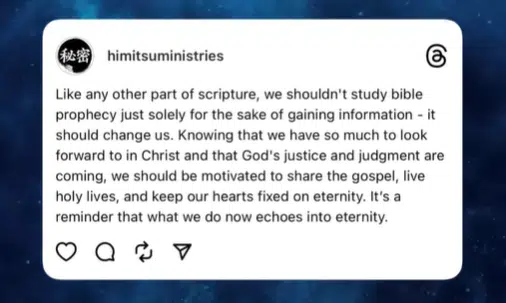
These are just a few reasons, but it’s clear that the study of Bible prophecy isn’t meant to simply fill our heads with knowledge. It should change how we live now and cause us to set our eyes on eternity.
Practical ways prophecy applies today:
- Encourages personal holiness and watchfulness
- Refocuses our priorities toward eternal values
- Increases urgency to share the Gospel
- Provides comfort during trials
What Does the Bible Say About Our Responsibility to Study All Scripture?
Regardless of the underlying reasons that may cause someone to not want to dig into Bible prophecy or any other area of scripture, the problem is the same – personal interest is prioritized over our responsibility to understand what scripture says.
We shouldn’t use our personal interest, which ebbs and flows, to supersede our responsibility to study the Word diligently (2 Timothy 2:15; 2 Timothy 3:16-17). Personal interest should not outweigh obedience.
There are many things in life that don’t necessarily interest us but yet we need to do those things. I may not be “interested” in going to work, but I still need to if I want to provide for my family. I may not be “interested” in attending to repairs around the house, but I’d better do it if I want to avoid things breaking down in the long run. This is similar to scripture.
The Bible was revealed to us by the God of the universe, and He decided to reveal certain things to us for our benefit, chief of which is the Gospel. All scripture is good for us (2 Timothy 3:16-17).
You may not be interested in finances, but the Bible speaks about it, and it would do us well to heed what it says about this area. You may not be interested in intelligent design and the specifics of the created order, but we should all be able to give a defense of our faith in some capacity (1 Peter 3:15; Jude 1:3). Likewise, this is true about eschatology. You may not be interested in this subject, but it’s still valuable to us and leaves a positive impact on our lives.
Our responsibility is to study the totality of scripture, and in doing so, our interest guides us to freely dig into a specific aspect of scripture we are more drawn to. A lack of interest should not prevent us from understanding Bible prophecy. Our focus shouldn’t be on our personal interest but instead on obedience to God and our spiritual growth.
When we study what God has revealed, we gain a broadened perspective on the events of our day, strength for tomorrow, and anticipation for eternity. Will you let disinterest hold you back from understanding one of the most hope-filled parts of Scripture?
 Support the Ministry